
Providence, RI · Garage Door Service
When a Spring Goes in Cold Weather, It's Not Random
Why Providence's 1960s-70s housing stock and severe cold winters make torsion springs fail hard in January, and what actually goes wrong when a spring breaks cold.
- Repairs & new doors
- Springs & openers
- Serving 7 nearby communities
How Local Conditions Play In
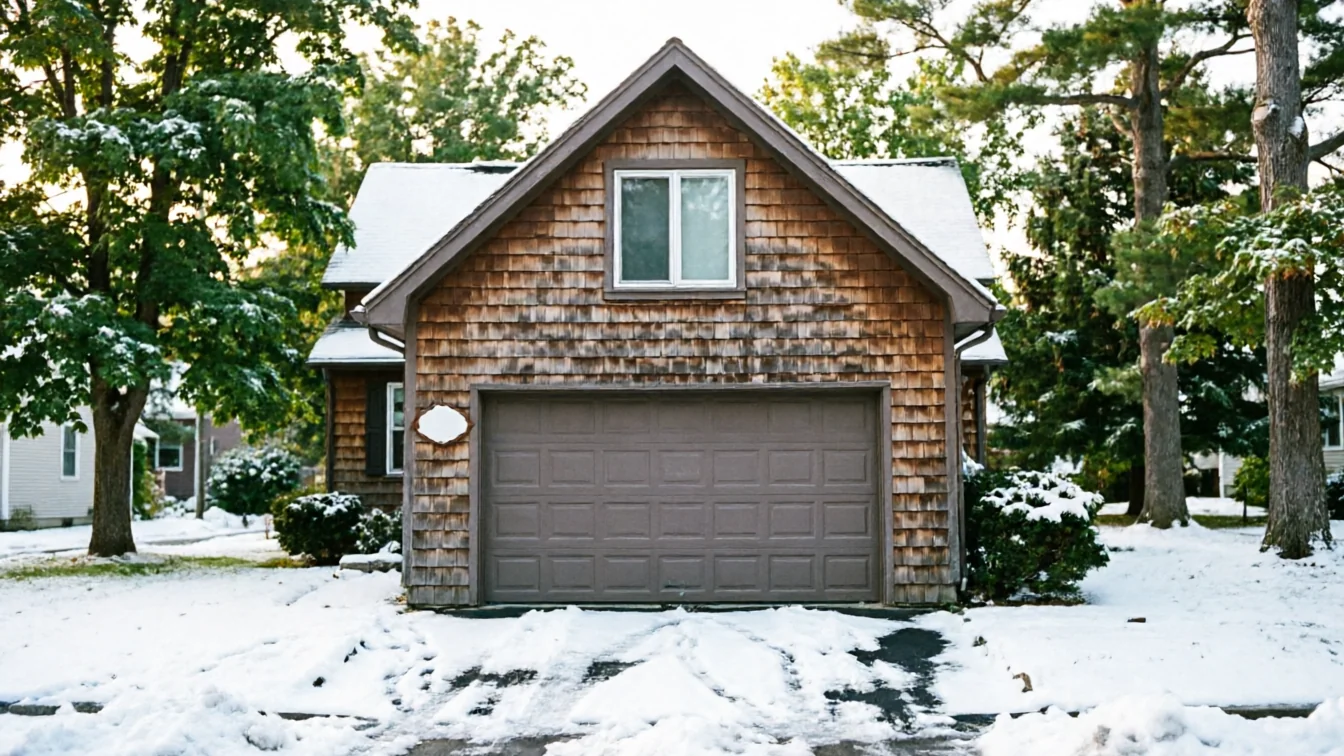
Most of the houses we work on in Providence went up somewhere between 1938 and 1989, with the median landing right around 1970. That's not a trivia fact - it means the garage doors on a huge share of these houses were installed, or replaced once, during an era when torsion springs were wound to a standard that didn't account for a Rhode Island winter the way current hardware does. Across the 34 named areas we run calls in, from Mount Pleasant to Edgewood to Rumford, the pattern repeats: 1960s and 70s construction, original or first-generation replacement springs, steel that's been cycling through hot summers and severe cold winters for fifty-plus years without anyone touching it.
Steel contracts in the cold. A spring that's been quietly losing tensile strength for decades doesn't announce itself in July. It announces itself in January, usually on the coldest morning of the stretch, when the metal is at its stiffest and least forgiving. The coil that would have flexed and held in August snaps clean instead. If your door is original to a house built in that 1938-1989 window, the spring inside it has already outlived what anyone expected of it.
Where People Go Wrong
The mistake we see most is someone noticing the door is "a little heavy" or "a little loud" in November and deciding to deal with it in spring, once the weather's easier to work in. By the time cold weather actually sets in, the spring that was marginal in November is now one hard pull away from breaking - and it breaks on the door's heaviest day, which in a cold climate band like ours is exactly when you don't want to be stuck outside.
The other common error is treating a broken spring as a quick swap without checking the rest of the system. On houses from this housing era, the track and rollers are often original too. Replace the spring alone on a door that's been riding worn rollers for fifty years and you've fixed one part of a system that's failing as a set. We'll tell you straight if that's what we're looking at - sometimes the honest answer is that the spring job buys you a year, not ten.
The Seasonal Bit
Our climate band is classified cold and severe, which matters more for garage doors than people expect. It's not the snow load on the door itself - it's the temperature swing acting on metal that's under constant tension. A torsion spring holds real stored energy all year, but cold steel is less elastic, so the same load that the spring absorbed smoothly in September gets transmitted as shock in January.
That's why the calls cluster the way they do: a quiet stretch through the fall, then a run of break calls as soon as we get a real cold snap. If you're in one of the areas built up in that 1960s-70s wave, the spring on your door has already been through forty-plus winters of that cycle. We can't tell you the exact day yours will go. We can tell you the stretch of weather that makes it likely.
What Is Going On
Put the two facts together and the picture is simple: a service area where the typical house dates to around 1970, sitting in a climate that swings hard cold, with springs that were never designed to be a fifty-year part. That combination is why spring failure here skews toward older torsion springs on original hardware rather than toward openers or newer doors.
We don't replace a spring that doesn't need it, and we won't tell you a cold snap alone means an imminent break - plenty of 1970s springs are still fine. What we will say is that if your door is original to a house from that era and it's starting to sound different, cold weather is the test it's about to fail, not the cause of the problem. The spring was already worn; the cold just finds the weak point first.
Frequently asked questions
Why does my garage door spring always seem to break in the cold?
Steel gets stiffer and less forgiving as it cools, so a torsion spring that's already weakened from decades of cycling tends to snap on the coldest days rather than mild ones. In our cold, severe climate band, that means breaks cluster during hard cold snaps, especially on springs original to houses built in the 1960s and 70s.
How do I know if my spring is original to the house?
If your house was built in the 1960s or 70s, which covers a lot of homes across this service area, and the door hardware looks dated - painted-over coils, older-style end bearing plates - there's a good chance it's original or a first-generation replacement. We can tell you more once we've had a look at the coil and the winding cone.
Is it worth replacing just the spring or the whole door?
Depends on the rest of the hardware. On houses from this era the track and rollers are often as old as the spring. If those are worn too, a spring-only fix buys you time but not much of it. We'll look at the whole system before recommending one over the other.
Related garage door services in Providence
More garage door guides
Book garage door service in Providence
Call now or request a quote - tell us what the door is doing and where you are.