
Providence, RI · Garage Door Service
Worth Fixing or Worth Replacing: Providence's Older Garage Doors
Providence homes mostly date to 1938-1989, many from the 1960s and 70s, with original hardware. Here's how to tell if your old garage door is worth fixing.
- Repairs & new doors
- Springs & openers
- Serving 7 nearby communities
How Local Conditions Play In
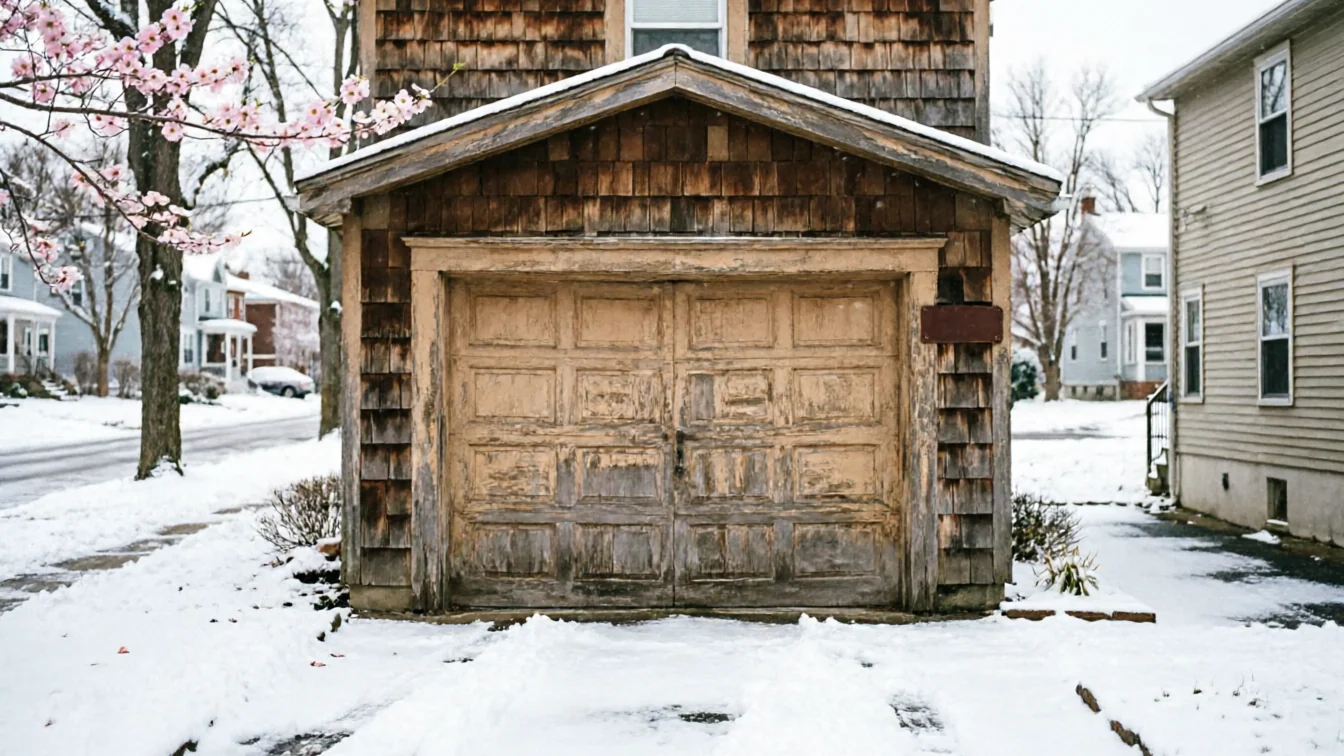
Most of the housing through Mount Pleasant, Hope, Washington Park, and the Blackstone Boulevard Realty Plat Historic District went up between 1938 and 1989, with the heaviest run in the 1960s and 70s. That matters more than people think. A door built in that stretch is almost always a one-piece or early sectional unit on side-mounted torsion hardware, bolted to framing that was never meant to carry today's heavier insulated panels. We see the same setup from Edgewood up through Rumford and across Riverside - different streets, same bones.
With 144,813 owner-occupied houses across the service area, a lot of what's out there is original or close to it. That's not a problem by itself. Plenty of those doors still run fine. The issue shows up when a spring finally lets go or a cable frays, and the homeowner is suddenly shopping for parts that match hardware nobody has made in forty years. At that point the honest question isn't "can this be fixed" - it almost always can - it's whether fixing it is the better use of the money versus putting in a door built for the load these openers are actually pulling now.
We don't guess at this from a truck window. The age of the house tells us what we're probably going to find before we even lift the door.
Where People Go Wrong
The most common mistake is chasing a symptom instead of the cause. A door that's gotten heavy to lift by hand usually has a spring that's lost tension, not a track problem - but people spray the rollers, wiggle the track, and call it fixed until the spring snaps outright, sometimes with the door halfway up.
The second mistake is assuming original hardware is automatically junk because it's old. A torsion spring and a steel track from a 1960s or 70s build can still be sound if the house was maintained - the age alone doesn't condemn it. What usually does condemn it is a door that's been through one too many openers upgraded over the decades without anyone checking whether the original track and drum were rated for the heavier unit.
Here's the limitation we're upfront about: if a panel is an obsolete profile from that era and the rest of the door is in rough shape, we're not going to chase down a matching replacement panel that doesn't exist anymore. At a median household income of $99,359 in this area, we'd rather tell you straight that a full door replacement is the better dollar-for-dollar call than have you pay twice - once for a patch, then again for the real fix a year later.
The Seasonal Bit
Providence sits in a cold, severe climate band, and that's the detail that ages hardware faster than the calendar does. A torsion spring that's been through decades of winter freeze-thaw cycling doesn't fail gradually - it holds right up until the morning it doesn't, usually on the coldest stretch of the season when the steel is least forgiving.
Rollers and track brackets take the same beating. Metal contracts in the cold, and on a door that's forty or fifty years old, the tolerances that were tight when the house was built have usually opened up just enough that a rough winter is what finally finds the weak point - a bent track, a worn roller stem, a spring that was already down to its last few hundred cycles.
This is why the calls cluster the way they do: not because anything particular happens on a given date, but because an older door that's marginal in October is the door that gives out in a hard freeze. If your door has been getting stiffer or noisier as it's gotten colder, that's not your imagination - it's the material doing exactly what cold, aged steel does.
What Is Going On
Put the pieces together and the pattern across this service area is pretty consistent. Housing built between 1938 and 1989, most of it clustered in the 1960s and 70s, sitting in a climate that's hard on steel hardware every winter. That combination means a huge share of the doors out there are approaching or past the point where repair and replacement cost roughly the same over a few years.
The way we actually sort it out is simple: we look at the spring, the track, and the opener as three separate questions, not one verdict. A spring is almost always worth replacing on its own - it's a contained job regardless of the door's age. A bent or rusted track on a door this old is a closer call, because fixing a track on hardware that old sometimes means the next failure is six months out instead of six years. And if the panels themselves are original and starting to show it, that's usually the point where a new door just makes more sense than another round of patch repairs.
None of that is a sales pitch for replacement over repair. Plenty of doors in this area are perfectly fixable and we'll tell you that. The point is just that "how old is it and what's it been through" is the real first question, not "what's broken today."
Frequently asked questions
My garage door is from the 1960s. Is it too old to repair?
Not automatically. Age alone doesn't condemn a door - a torsion spring or track from that era can still be sound if it's been maintained. What we check is whether the hardware was ever upgraded to handle a heavier opener than it was built for, since that's usually what pushes an old door from fixable to not worth it.
Why did my spring snap in the middle of winter?
Providence sits in a cold, severe climate band, and steel hardware ages faster under repeated freeze-thaw cycling. A spring that's down to its last few hundred cycles usually gives out on a hard cold stretch, not a mild one - the cold is what finds the weak point, not what causes it.
Can you match the panel on my original door?
Sometimes, sometimes not. A lot of houses in this area still have doors from the 1938-1989 build era, and some of those panel profiles aren't made anymore. If we can't match it and the rest of the door is worn too, we'll say so rather than chase a part that doesn't exist.
Is it cheaper to fix the track or replace the whole door?
Depends on what we find. A bent or rusted track on a door that's decades old is a closer call than a spring, because the next failure point might be close behind it. We look at spring, track, and opener as separate questions before giving you a number either way.
Related garage door services in Providence
More garage door guides
Book garage door service in Providence
Call now or request a quote - tell us what the door is doing and where you are.