Providence, RI · Garage Door Service
New Garage Door Installation, West Warwick, RI
West Warwick's housing dates mostly to the late 1960s, so original doors and openers are past due. What a new install costs, carries, and involves here.
- Repairs & new doors
- Springs & openers
- Serving 7 nearby communities
What Causes It Around Here
Start with the money, because it decides more than people expect. West Warwick's median household income runs $73,903, well under the $99,359 median across the wider Providence service area. That gap matters for garage doors: it's the line between a homeowner who replaces a worn door with a comparable steel unit and one who stretches a repair another few years because a full insulated upgrade doesn't pencil out yet.
The housing underneath that decision skews older. This town's median build year sits around 1967, inside the broader service area's 1938-to-1989 window but closer to the middle of it. Doors and openers installed with those houses, or replaced once already in the decades since, are now old enough that panels have oxidized, torsion springs have cycled past their rated life, and openers are the kind with a pull-chain and no safety reversal sensors. Add a COLD-severe climate zone on top of that and steel panels without thermal breaks take a harder beating each winter - seams widen, and bottom seals crack before the rest of the door shows its age.
None of that is a West Warwick-specific defect. It's what houses built around 1967 do, in a climate this cold, once income makes full replacement a later decision rather than an immediate one.
How We Fix It
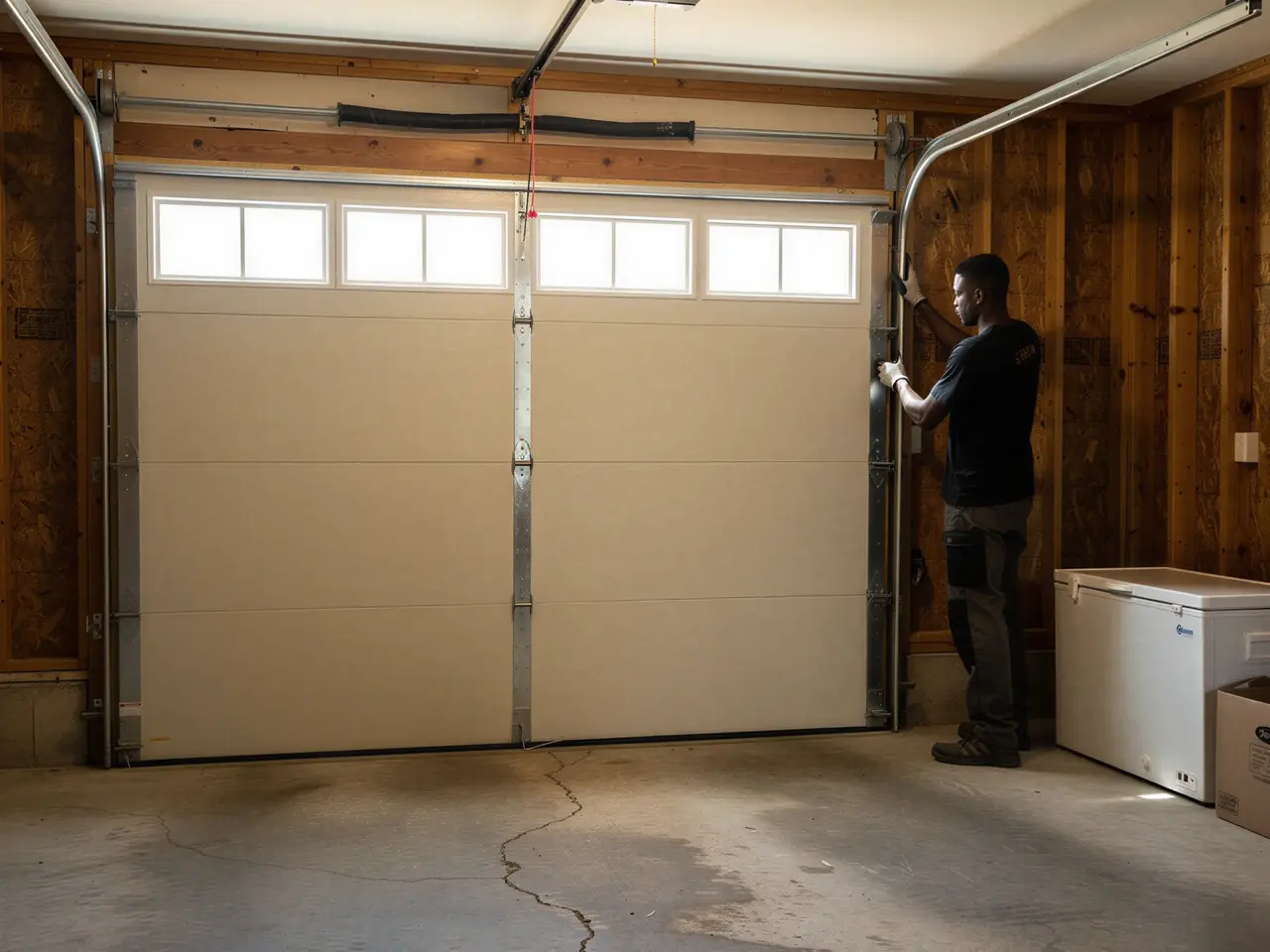
A new install starts with measuring the actual opening, not assuming it matches a catalog size - houses from this era were often framed by hand, and headers can be an inch or two off from what a stock door expects. We pull the old door and track off the hardware, check the jambs for rot or settling, and reset the vertical tracks plumb before anything new goes up.
From there it's a new steel or insulated door matched to the opening, new torsion spring sized to the door's actual weight rather than guessed at, and a new opener with a safety reversal sensor if the old one is a bare chain-drive unit, which on houses from the late 1960s it often is. We test balance by hand before we ever power the opener, because a door that isn't balanced will burn out a new opener just as fast as it burned out the old one.
We don't paint over rot. If the jamb or header behind the old trim has gone soft, that gets flagged before the new door goes in, not after.
What You Pay
We don't post a flat price here, because the span between a basic steel door and an insulated carriage-style unit is wide, and what you need depends on the opening and what's behind the trim once the old door comes off. What we can say is how the decision tends to shake out locally: with a median household income of $73,903 here, well under the $99,359 median for the broader service area, most of the installs we see lean toward solid value steel doors rather than top-tier insulated models, and that's a reasonable call, not a downgrade.
The honest limitation is that we can't quote a firm number sight unseen. A door that needs new track and jamb repair alongside the panel costs more than a straight swap onto sound framing, and on houses from this era that difference shows up more often than on newer construction. We'll give you a real number after we look at the opening, not before.
Parts We Carry
We stock the parts that fail most on doors from this era: torsion springs in the common residential sizes, galvanized lift cables, nylon and steel rollers, and standard track sections. Openers we install come with safety reversal sensors as a baseline - no exceptions, regardless of what the old unit had.
What we don't keep on the truck is anything custom-cut to an odd opening. If the house has a header that was framed a size off from standard, which happens on houses built around 1967 more than on newer stock, that panel or track section may need to be special-ordered, and that adds to the timeline. We'll tell you up front if your opening falls into that category instead of promising a part we don't have.
How Long You Are Without the Door
We run out of Providence, 11 miles from here, so the schedule accounts for that drive rather than pretending it isn't a factor. Once we're on site, a standard install on a sound opening with in-stock parts is typically a same-visit job. What stretches it is anything behind the door itself - rotted jamb framing, a header that needs rebuilding, or a custom-size panel that has to come from a supplier.
We'll tell you at the estimate which category your job falls into. If it's a straight swap, you're looking at one visit. If the opening needs rebuilding first, we'll give you a real timeline instead of a guess, because on a house with a 1967-era frame behind the trim, that's not rare.
Where This Job Goes Sideways
The surprise on houses this age is almost always behind the door, not the door itself. Pull an original or early-replacement unit off an opening framed around 1967 and you sometimes find a header that's undersized by today's standard, jamb wood gone soft from decades of condensation, or a track bolted to framing that's shifted slightly out of plumb. None of that shows from the outside.
When that happens, the honest call is to fix the framing before the new door goes in, even though it adds a step. Hanging a new door on a bad header just moves the failure a year or two down the road. The other place this goes sideways is cost expectations: with a town median income under the area's average, a homeowner budgeting for a straight panel swap can be caught off guard by a framing repair add-on. We'd rather flag it at the estimate than let it show up as a surprise on the invoice.
Frequently asked questions
Is my garage door opener too old to keep if I replace just the door?
If your house dates to around the 1967 median for this area and the opener is a bare chain-drive unit without a safety reversal sensor, we won't reinstall it on a new door. Sensors are a baseline on anything we hang now. If your opener already has them and still runs well, it can usually stay.
Do you carry parts for older torsion springs on the truck?
We stock the common residential torsion spring sizes, along with standard cable, rollers, and track. What we don't carry is anything custom-cut for a non-standard opening, which does turn up more often on houses framed before current building standards were common.
Why would a straight door swap turn into a bigger job?
On houses from this era, the header or jamb behind the old door sometimes needs repair once it's exposed - rot, slight settling, or framing that was never quite standard size. We check for that before we commit you to a price, and we'll tell you plainly if it changes the job.
How far out is Providence Garage Door Pros coming for this?
We travel from Providence, about 11 miles out. We build that into scheduling rather than promising a same-day slot we can't guarantee. At the estimate, we'll give you a real timeline based on the actual job, not a generic one.
More garage door services in West Warwick
Book garage door service in Providence
Call now or request a quote - tell us what the door is doing and where you are.