
Providence, RI · Garage Door Service
Garage Door Repair for Pawtucket's Postwar Housing Stock
Pawtucket's garage doors mostly date to the late 1940s building boom, older and narrower than the area norm. We travel 4 miles from Providence to fix them.
- Repairs & new doors
- Springs & openers
- Serving 7 nearby communities
What You Pay
We don't quote a number without seeing the door, because Pawtucket's mix skews older than the wider service area - the median home here went up around 1947, a good two decades ahead of the 1970 median across the rest of the territory. That gap matters for price. A door from that era is often a narrower single-car opening on an extension-spring setup, not the wider double-wide torsion systems common in homes built in the 1960s and later. Parts for the older configuration aren't always interchangeable with what we carry for newer stock, and sourcing the right bracket or drum can add time to a job that would be quick on a newer house.
What we can tell you without seeing the door: a broken spring, a worn cable, or a bad roller on an older extension-spring door is usually a smaller job than replacing a torsion system, and a full door swap costs more than any repair. We price the actual job, not a zip code. If the hardware on your door is original to a 1947 build, say so when you call - it changes what we bring on the truck.
We travel in from Providence, about 4 miles out, so there's no local branch markup and no travel surprise buried in the invoice.
How We Fix It
On a door this old, we start by figuring out what's original and what's already been swapped. A lot of 1940s-era garages in this area have had at least one opener retrofit since, and the mounting hardware from that retrofit doesn't always match what the door itself was built for. We check the track alignment first - on a narrower single-car opening, even a small amount of drift in the vertical track binds the rollers and looks like a spring problem when it isn't.
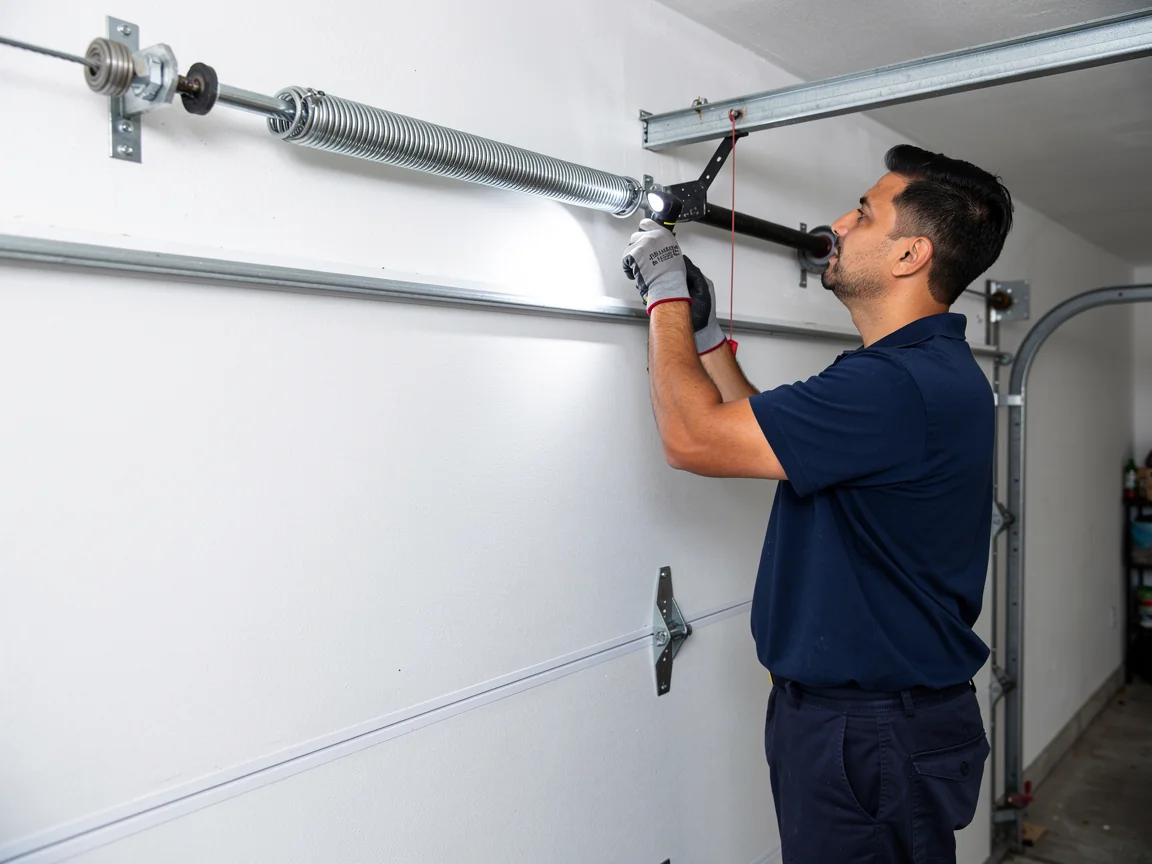
If it is the spring, we match tension to the door's actual weight rather than assuming a standard size. Older wood-panel doors run heavier than the steel sectional doors that became common later, and an extension spring sized for a lighter door will fail again within months. We set it right the first time or we don't leave.
Where the job gets slower is when the opener is newer than the door. Bolting a modern opener arm to an old wood panel means checking the panel can actually take the stress without splitting, which takes an extra look before we commit to the install.
Parts We Carry
We stock the hardware that covers most of what shows up on an area built mostly between the late 1930s and the 1980s - standard torsion springs, extension spring sets, rollers, cables, and the brackets that fit sectional steel doors from that whole span. Pawtucket's own stock, running older than the region's median, means we also carry extension-spring hardware more often than we would for a newer suburb, since that's still what's bolted to a lot of these garages.
What we don't carry on the truck is anything custom-milled for a wood panel door that's been patched or resized over the years. If your door is an original wood panel from the 1940s and it's been cut down or re-hung at some point, we may need to order a part rather than swap it on the spot. That's the honest limit - we're not going to improvise a fix on hardware we don't trust.
Where This Job Goes Sideways
The call that turns into a longer job is almost always the same shape: someone tells us the door won't open, and when we get there the real issue is a track that's been bent or a bottom bracket that's rusted through on a door that's been limping along for years. On the older single-car openings common in this part of the area, there's less tolerance for misalignment than on a wider modern door - a quarter inch of drift that a newer door shrugs off will bind a 1947-era track completely.
The other way it goes sideways: a homeowner's had a cheap opener bolted onto an old door by somebody who didn't check whether the panel could take the load. We've seen the arm pull loose from a wood panel that was never reinforced for powered operation. Fixing that right means reinforcing the panel or recommending replacement, not just rehanging the arm and hoping.
What Causes It Around Here
Two things drive most of the calls we get from this part of the territory. First, the age of the housing - a door built around 1947 has had roughly three-quarters of a century to wear through springs, rollers, and cables that have likely already been replaced once or twice by someone else. Second, the winters. This area sits in a cold climate band with real seasonal swings, and steel contracts in the cold, which tightens tolerances on tracks and hardware that are already decades old. A roller that was marginal in October can jam solid in January.
Median household income here runs lower than the broader service area - $67,436 against $99,359 across the territory as a whole - and that shows up in how people maintain these doors. More of the calls we take in Pawtucket are deferred maintenance finally catching up, not sudden failures on well-kept equipment. There's nothing wrong with that; it just means we see more worn-out original hardware than we do in newer, higher-turnover neighborhoods.
Doing It Yourself
Lubricating hinges and rollers, checking that the photo-eye sensors are clean and aligned, and tightening loose bolts on the track brackets are all fine to do yourself, on any door regardless of age. Lower the door and look at the springs: if you see a gap in the coil or a spring that looks stretched unevenly, stop there.
What you shouldn't touch is the spring itself, on any door, but especially on an older extension-spring setup. These doors use a style of hardware most newer homeowners have never worked with, and the failure mode - a spring letting go under tension - can break bones or worse. If your door is original to a home built in this era, we'd rather walk you through what to check by phone than have you open the spring cup yourself.
Frequently asked questions
Is my garage door original to the house if it was built around 1947?
It's possible but not guaranteed - a lot of homes from that era have had at least one door or opener replacement since. Look at the hardware: extension springs running alongside the horizontal track usually point to an older original setup, while a torsion spring mounted above the door usually means a later replacement.
Do you carry parts for older wood panel doors?
We stock hardware - springs, cables, rollers, brackets - that fits most doors from this era, including extension-spring setups common on older single-car openings. Custom-milled wood panel replacements sometimes need to be ordered rather than pulled off the truck.
How far do you travel for a Pawtucket call?
We run out of Providence, about 4 miles from Pawtucket. There's no local branch here, so we quote the job itself, not a separate travel charge for the distance.
Why does cold weather make an old door worse?
This area sits in a cold climate band with real winter swings, and steel contracts as it gets colder. On a door with decades-old tracks and hardware, that contraction tightens tolerances that were already worn, which is why so many older doors act up in January that were fine in the fall.
More garage door services in Pawtucket
Book garage door service in Providence
Call now or request a quote - tell us what the door is doing and where you are.